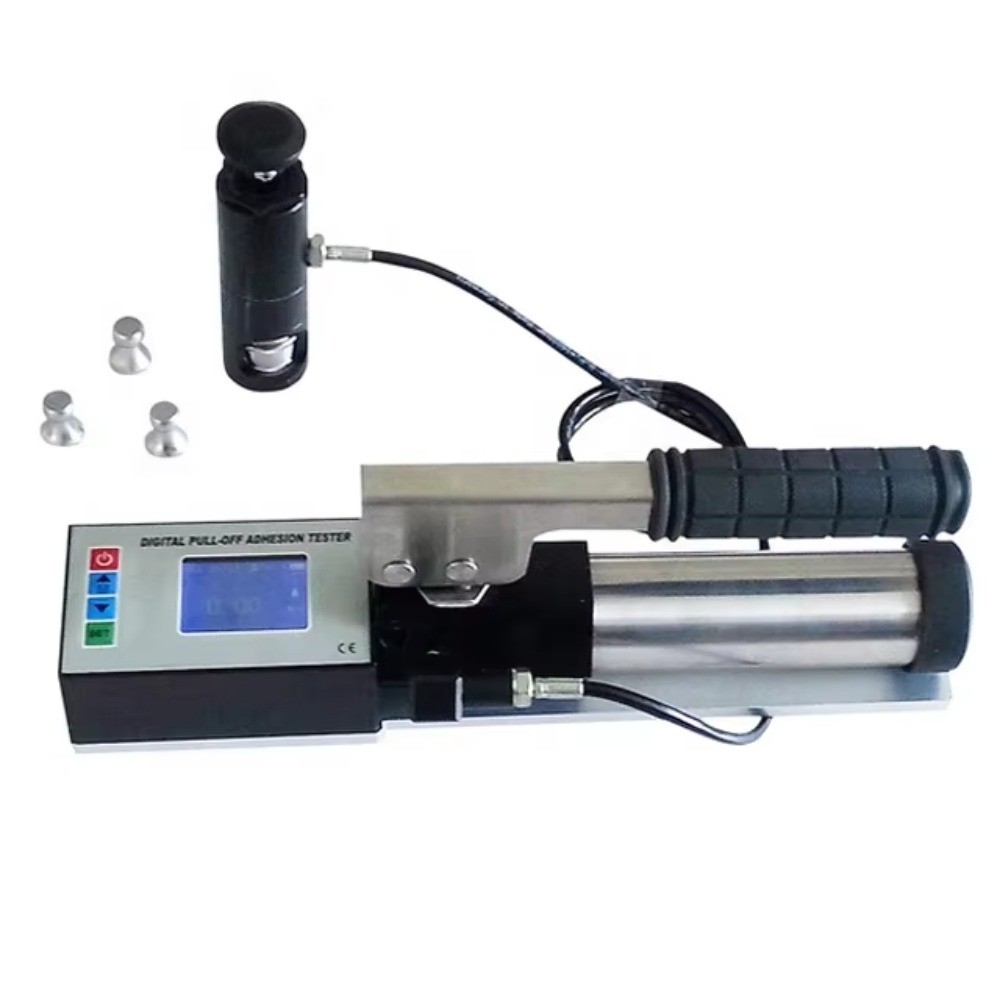
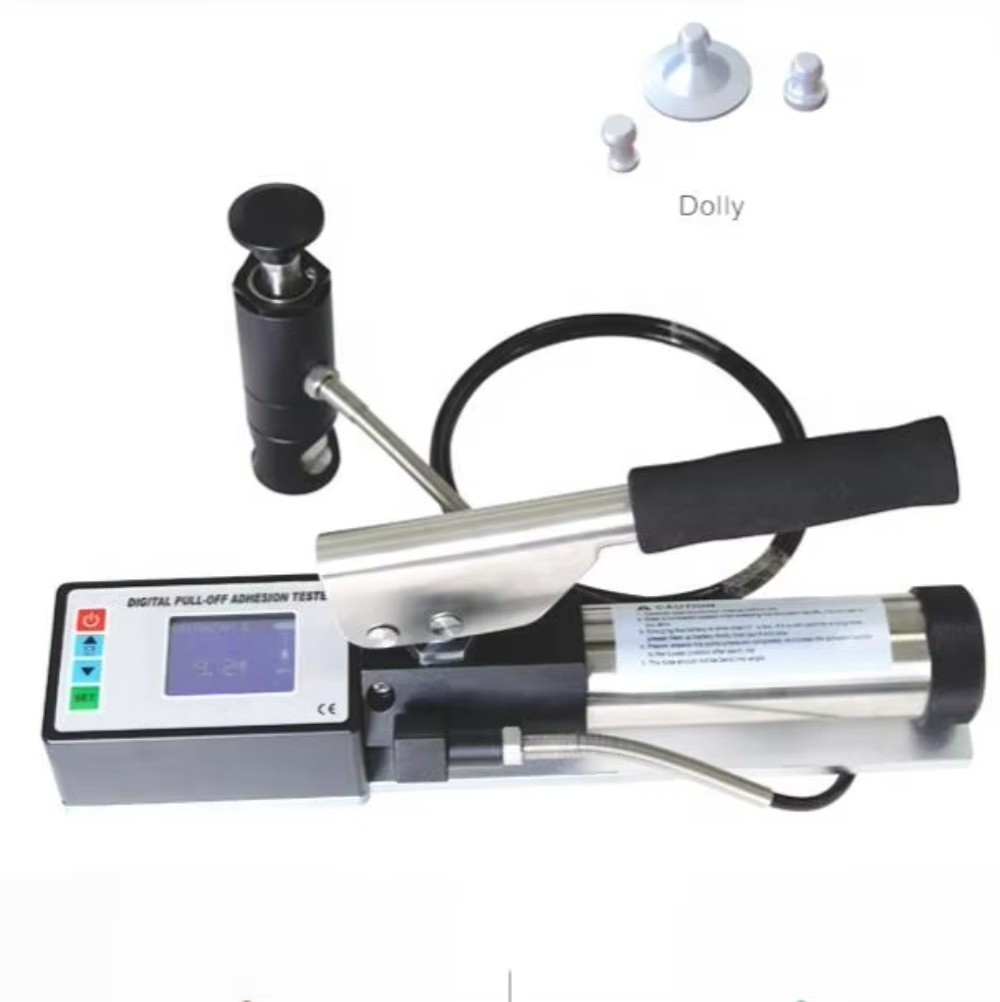
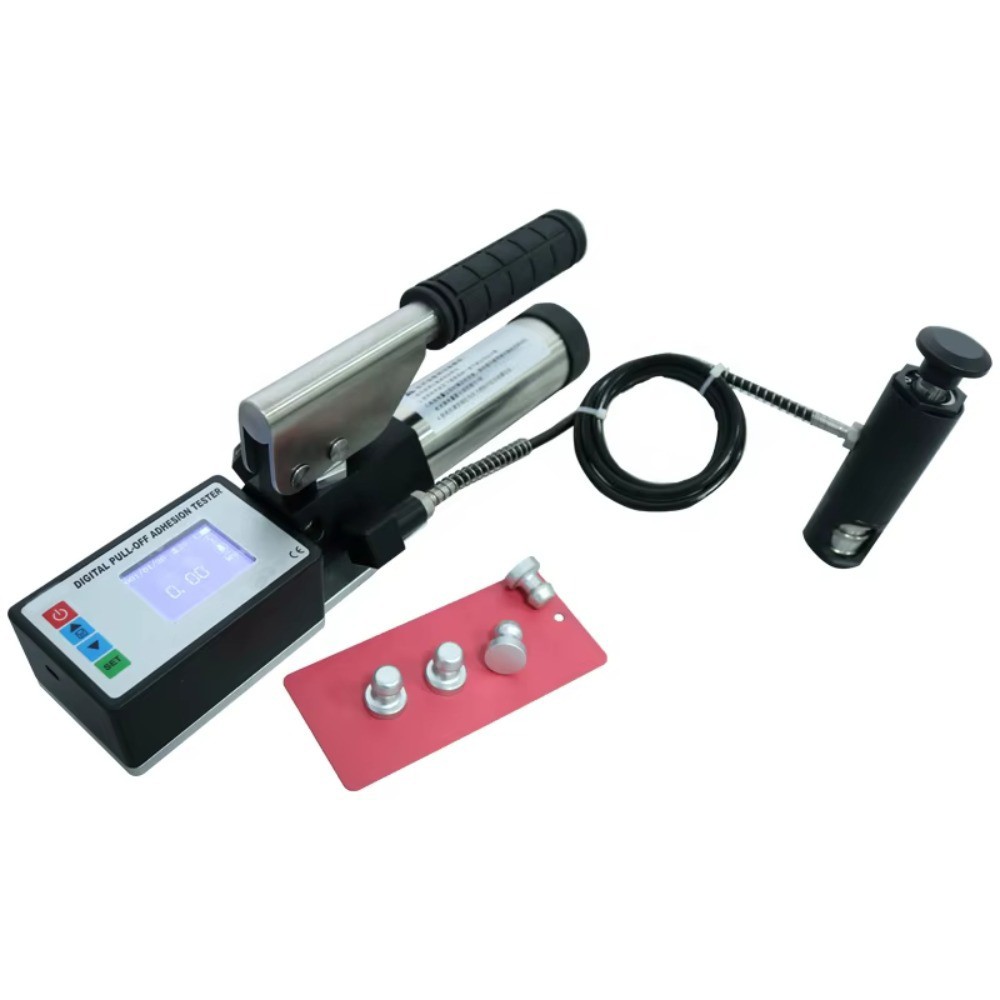
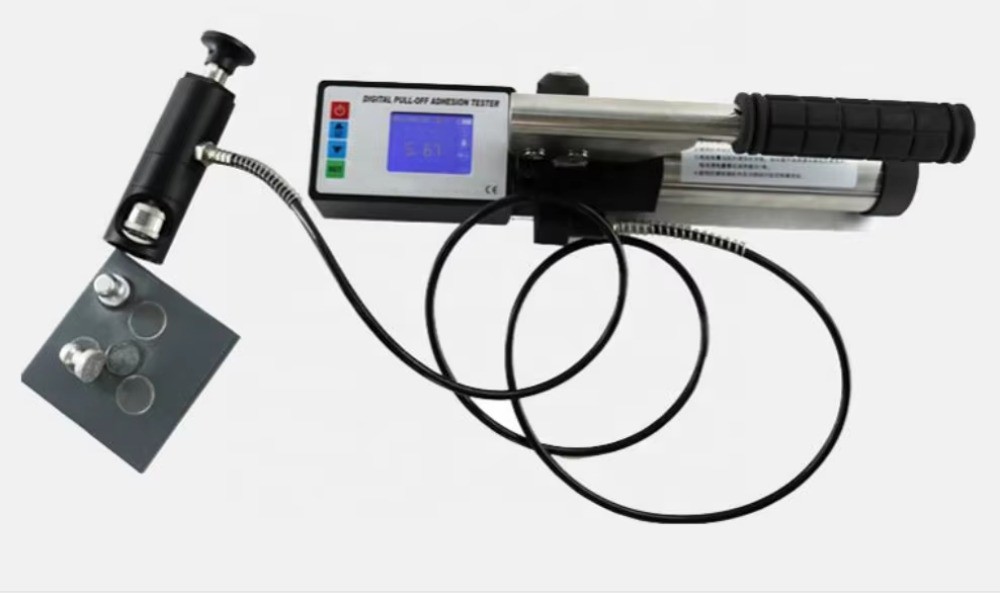
Paint Coating Adhesion Tester
- Product Item : ZHIYI-920
- Category: Paint,Coating&Ink
- Adhesion Tester
- paint Adhesion Tester
- coating Adhesion Tester
- Product description:The digital adhesion tester is a portable, manual instrument used to measure the force required to pull a coating of a specified test diameter away from its substrate using hydraulic pressure. The pre
Product Introduction
The digital adhesion tester is a portable, manual instrument used to measure the force required to pull a coating of a specified test diameter away from its substrate using hydraulic pressure. The pressure is displayed on a digital LCD and indicates the adhesion of the coating to the substrate
It evaluates the adhesion (tensile strength) of a coating by determining the maximum tensile pull force it can withstand before separation. Breaking points evidenced by the fracture surface appear along the weakest plane of the system, which consists of a trolley, adhesive, coating, and substrate.
Standards
ISO 4624 (Paints and varnishes. Adhesion Breaking Tests)
ASTM D 4541 (Standard Test Method for Pull-Off Strength of Coatings Using a Portable Adhesion Tester)
ASTM D7234 (Standard Test Method for Pull-Off Adhesion Strength of Coatings on Concrete Using a Portable Pull-Out Adhesion Tester)
GB/T 5210 (Adhesion test of color and varnish drawing method).
Application
Cross-section test
This test method specifies a procedure to evaluate the resistance of paints and coatings to separation from the substrate when a right-angle lattice pattern cuts into the coating and penetrates the substrate.
This method can be used for fast pass/fail testing. When applied to a multi-coating system, the resistance of individual coatings to separation from each other can be evaluated.
Adhesion
This test method covers the determination of adhesion when organic paints, varnishes and varnishes are applied to smooth, flat (flat) panel surfaces. It has been found to be useful to provide relative ratings for a range of coated panels that exhibit significant differences.
The material being measured is applied to the flat plate at a uniform thickness, usually a sheet of metal with a uniform surface texture. Once dry, adhesion is determined by pushing the panel under a circular stylus or ring that increases in weight until the coating is removed from the surface of the substrate.
Pull-off test
The adhesion of a single coating or multi-coating system of paints, varnishes, or related products is evaluated by measuring the minimum tensile stress required to separate or crack the coating in a direction perpendicular to the substrate. This method maximizes tensile stress compared to shear stress applied by other methods, such as scratch adhesion, and results may not be comparable. The test is performed by securing a loading fixture (dolly) perpendicular to the coating surface with adhesive. Once the adhesive has cured, the test equipment is attached to the loading fixture and aligned to apply tension perpendicular to the test surface. The applied force is gradually increased and monitored until the stopper of the coating material is removed or a specified value is reached.
Technical Data
|
Dolly size |
20 mm (standard); 10 mm, 14 mm, 50 mm (optional) |
|
Resolution |
0.01 megapascal (1 psi) |
|
Accuracy |
±1% full scale |
|
Maximum pull-off pressure |
Φ10mm
Dolly → 0-80 megapascals; Φ14 mm Dolly &
rarr; 0-40 megapascals; |
|
Power |
Built-in rechargeable lithium battery, charging adapter as standard |
|
Dimensions |
360 mm × 75 mm × 115 mm (L x W x H). |
|
Weight |
3kgs |
CATEGORIES
- Textile Testing Equipment
- Paint,Coating&Ink
- Paper, Packaging & Print
- Plastic tester machine
- Whiteness Meter
- Environmental Test Chamber
- Color and Gloss meter
- Color Assessment Cabinet
- Metal Testing Instrument
- Particle Size and Shape Analyzer
- Coating Thickness Gauge
- Electronic Balance
- Tensile Testing Machine
- Density Meter
- Color Fan Deck
- UV Spectrophotometer & Spectrometer
- Other
LATEST NEWS
- Mooney Viscometer: Quality Indicato…
- Factors Causing Instability of the …
- Functions of Carbon & Sulfur Analyz…
- In-depth Analysis of Gas Chromatogr…
- Application of contact angle tester…
- Test Method for Sealing Performanc…
- Bottle Cap Torque Tester…
- Hardness testing of metallic materi…
- Applications of melt flow indexer…
- Introduction of new Hydraulic Flat…
- Guide to Maintenance of Drainage Sy…
- Constant Temperature and Humidity C…
- Common Faults and Solutions for COD…
- Tape peeling test of tensile testin…
- Understanding the sampling frequenc…
- Application of melt flow indexer (…
- Revolutionizing Precision: Digital …
- Application Solution for Oil and Fa…
- A Critical Tool for Ensuring Mater…
- Quality monitoring for recycled pap…
Contact
CONTACT USName: Jennifer
Mobile:+86 13336040868
Tel:+86 13336040868
Whatsapp:+86 13336040868
Email:sales@iqctest.com
Add:No.51 of Xiba Road,Wuchang Street, Yuhang District, 311100 ,Hangzhou City, China