News
Application of contact angle tester
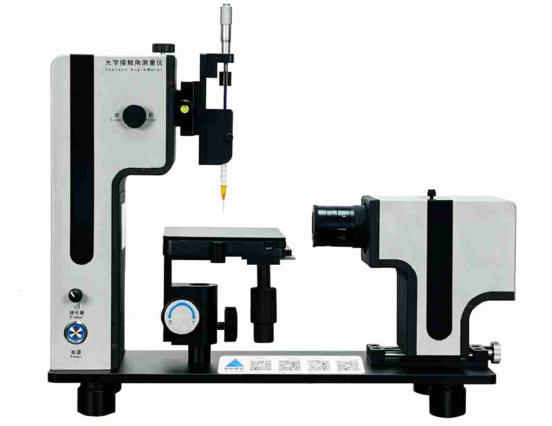
A contact angle meter is used to measure the surface tension of solids, liquids, and the contact angle. Its working principle involves dropping a certain volume of liquid onto the surface to be measured, capturing an image of the interface between the droplet and the surface using a high-resolution camera, and then analyzing the geometry and characteristics of the interface to calculate the contact angle and surface tension.Contact angle meters have wide applications in surface physical chemistry, coating technology, nanomaterials, and biomedicine. They offer advantages such as high measurement accuracy, fast testing speed, and simple operation, providing crucial information about the properties of solid-liquid interfaces.
In the biomedical field, contact angle meters can be used to study the wettability, lubrication, and cell adhesion of biomaterial surfaces. Specific applications include:
Studies on the wettability of biomaterial surfaces: Contact angle meters can be used to measure the wettability of biomaterials, such as artificial blood vessels, artificial bones, and biomaterials like artificial joints. By measuring the contact angle, the wettability and surface energy of biomaterials can be evaluated, providing a reference for the design and development of biomedical materials.
Cell Adhesion Studies: Contact angle meters can be used to study cell adhesion on biomaterial surfaces, such as the adhesion of human cells to biomaterial surfaces. By measuring the contact angle and surface tension, the hydrophilicity and hydrophobicity of the biomaterial surface can be evaluated, thereby predicting cell adhesion on the biomaterial surface.
Drug Release Studies: Contact angle meters can be used to study drug release from biomaterial surfaces, such as the wettability of material surfaces in drug delivery systems. By measuring parameters such as contact angle and surface tension, the adsorption and release characteristics of drugs on biomaterial surfaces can be assessed.
Biofilm Studies: Contact angle meters can be used to study the hydrophilicity and hydrophobicity of biofilm surfaces, such as cell membranes and bacterial membranes. By measuring the contact angle and surface tension, the wettability and surface energy of the biofilm surface can be assessed, thus providing relevant data for biofilm research.
RELATED NEWS
NEWS CATEGORIES
LATEST NEWS
- Differences of Cantilever‑Beam and …
- Mooney Viscometer: Quality Indicato…
- Factors Causing Instability of the …
- Functions of Carbon & Sulfur Analyz…
- In-depth Analysis of Gas Chromatogr…
- Application of contact angle tester…
- Test Method for Sealing Performanc…
- Bottle Cap Torque Tester…
- Hardness testing of metallic materi…
- Applications of melt flow indexer…
- Introduction of new Hydraulic Flat…
- Guide to Maintenance of Drainage Sy…
- Constant Temperature and Humidity C…
- Common Faults and Solutions for COD…
- Tape peeling test of tensile testin…
- Understanding the sampling frequenc…
- Application of melt flow indexer (…
- Revolutionizing Precision: Digital …
- Application Solution for Oil and Fa…
- A Critical Tool for Ensuring Mater…
Contact
CONTACT USName: Jennifer
Mobile:+86 13336040868
Tel:+86 13336040868
Whatsapp:+86 13336040868
Email:sales@iqctest.com
Add:No.51 of Xiba Road,Wuchang Street, Yuhang District, 311100 ,Hangzhou City, China